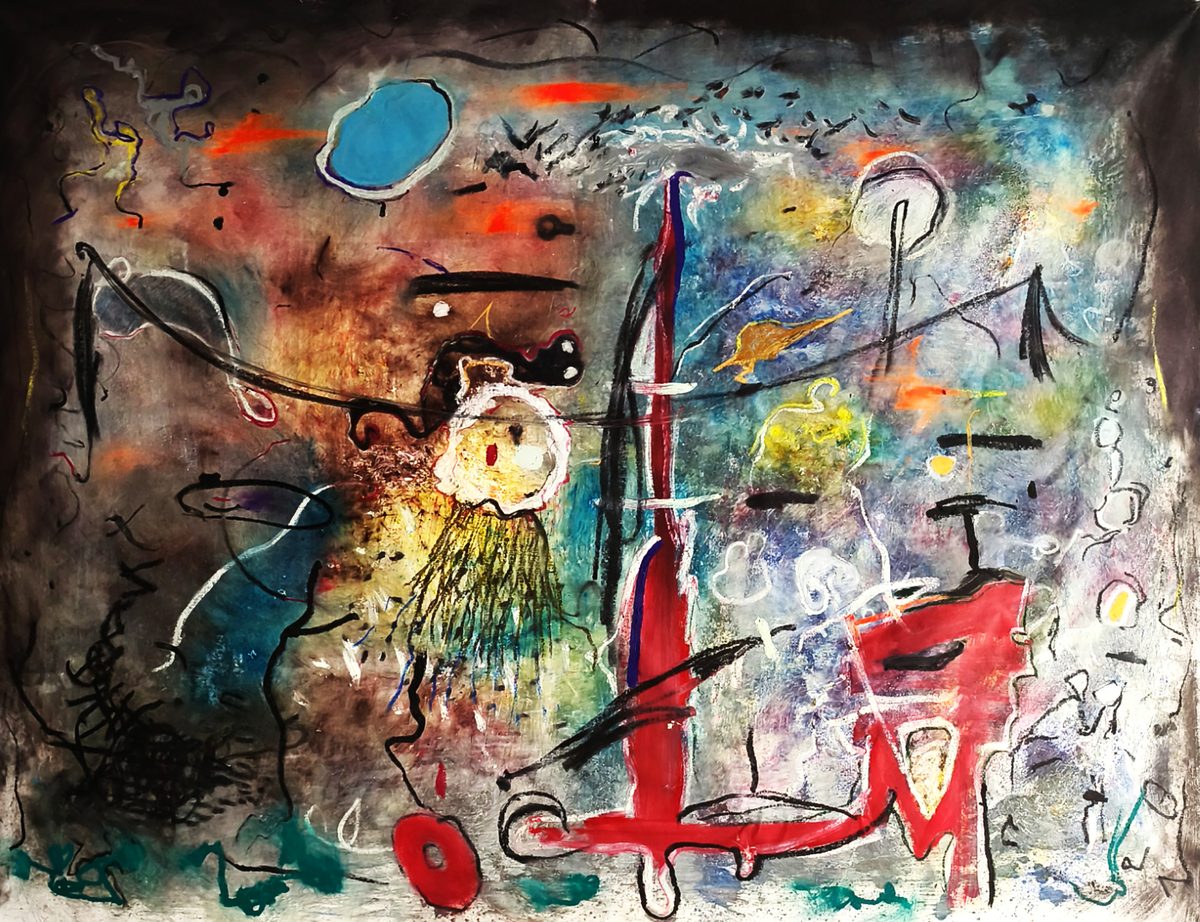
Curatorial Analysis — Plan B (160 × 210 cm, oil on canvas)
Plan B is a vivid meditation on survival and identity. Through a composition of layered complexity, the painting channels the emotional spectrum of human experience — its suffering, its joy, and its resilience. Stoop's expressive use of colour and gesture is contrasted by precise, meaningful details, creating a dynamic tension that speaks directly to the viewer. The artist's unique, irrational visual language constructs an abstract concept that nonetheless evokes deeply human sensations.
Plan B arrives with an urgency that sets it apart from Stoop's other recent works. Where The Unknown and Presence propose contemplative fields — spaces of sustained encounter — Plan B erupts. The canvas is a theatre of simultaneous events: a figure with a radiant, almost totemic head occupies the left-centre; a blazing red vertical tears upward through the composition; a blue oval floats above like a displaced planet; a flock of black birds scatters across the upper register with the randomness of thrown ink.
What Stoop has constructed here is not a composition in the traditional sense but a field of coexistence — of forms and forces that refuse to resolve into hierarchy or sequence. The eye moves continuously, pulled from the figure to the birds to the red form to the teal shadows at the lower edge, finding no single point of rest. This restlessness is not accidental; it is the subject.
The title is precise and poignant. Plan B implies that something has already been attempted and found wanting — that what we see is not the original intention but the necessary response to its failure. In this sense the painting is also a philosophical statement: that survival requires improvisation, that identity is constructed from what remains after the first plan collapses.
This work is not merely a painting — it is a state of being, captured in the moment of creation. It invites the viewer into an intimate, inner ocean, one that mirrors the raw truth of our own existence. Plan B is emblematic of Stoop's broader artistic practice: a search for authenticity, for presence, and for the transformative power of abstraction.
It is among the most emotionally direct works in Stoop's recent practice — and the most openly narrative, even as it refuses the comfort of a legible story. It opens a door — not just to a painting, but to a way of seeing.